
Archives for category: Uncategorized
Peter Schneider während der Veranstaltung „Und immer wieder sät man aus den Samen“ im Berliner Kulturforum.
https://creativecommons.org/licenses/by-sa/4.0

The author Peter Schneider died on 3 September 2026.

This is what I wrote about him in my book Writing the Revolution. The Construction of “1968” in Germany (Camden House 2016, 107-110; 197-199):

Between Scylla and Charybdis 

… it was his novel Skylla (2005), an essay on Napoleon Bonaparte’s observation: What is history but a fable agreed upon? that provided a genuinely new perspective on “1968.” The protagonist is Leo Brenner, a former activist in the German student movement, now a successful Berlin solicitor specializing in divorce cases. Fleeing rainy Tuscany one holiday, he buys a plot of land on a hill in Latium and builds a house with a view for his family. He and his young wife Lucynna, an archeologist, unearth a mosaic below their terrace, and explore the myth of the monster Skylla as they become involved in a race to reconstruct a sculpture that was the original source for the mosaic. Among the daily frustrations of house-building and a second narrative strand that explores the time of emperor Tiberius, in whose cave in Sperlonga the sculpture was originally set, we come to what appears to be a minor narrative detour, but which proves to be the center of the novel. Brenner encounters a former comrade from his student days, Paul Stirlitz. This down-on-his-luck drifter, who scrapes a living helping affluent 68ers to build their second homes in Italy, confronts Brenner with his past as agitator and student leader. 

Brenner initially has no recollection of Stirlitz (an indication of the passage of time and his “successful” integration into bourgeois society) but is forcefully reminded that not all 68ers managed to leave their past behind. Skillfully reflecting the debate of the time, Schneider lets his characters take opposite sides on how to remember the German student movement, either as a time of “brutale[n] Parolen und Welterlösungsformeln” (brutal slogans and formulas for saving the world), or as a “wunderbare und notwendige Revolution” (wonderful and necessary revolution). It soon becomes clear that Brenner and Stirlitz are not only fighting about the historicization of their own past but also its legitimization. For Stirlitz, the accepted history of “1968” is one big lie: 

Memory is a tricky thing. [. . .] In retrospect, perpetrators are always innocent, and they love to play the role of the victim. This was the case with our fathers, and it’s no different with us, the self-styled anti-fascists and revolutionaries. Most innocent of all are always those who plan a deed in their mind, but leave the dirty work of execution to others. Murderous slogans, shouted at a teach-in, are much easier to forget than murder, don’t you think?49 

Stirlitz reminds his former comrade of the time when Rudi Dutschke was shot, willing Brenner to admit that as a leading figure in the movement he had been instrumental in enticing many young people to violence with the slogan “Sprengt Springer!” (Blow Up Springer!). Faced with this “self-appointed judge,” Brenner adamantly refuses any admission of guilt that Stirlitz so eagerly expects from him. The reason for this becomes obvious when Stirlitz confesses that he had interpreted the slogan as a call to action. He had prepared a bomb that was intended to damage the Springer headquarter in Berlin but instead had killed two innocent people. Brenner feebly protests that his slogan had had no militant meaning, that it had simply been a case of following “der Logik des Stabreims” (the logic of alliteration), but Stirlitz, eaten up by his feelings of guilt, demands that Brenner accepts his part of the responsibility for the consequences of his actions. 

Initially, the solicitor defends himself vigorously: “I never planned a bomb attack, let alone participated in one. The only thing you can accuse me of is having been too lax in my choice of words,” but he begins to have doubts when Stirlitz steals the mosaic, an act that causes the disappearance of Lucynna and Brenner’s “Läuterung” (purification): 

And should I not accept a share of the blame, a moral complicity? Did my slogan not contribute to a climate in which someone like Paul Stirlitz could imagine himself a hero by doing what—truth be told—everyone wanted to do?

At this point, Schneider widens the scope of his archeological dig. Brenner meets with one of the archeologists who are trying to recreate the Skylla sculpture, who explains to him: 

People want to know where they come from, and through this hope to find out who they are and where they are going. Historiography is a battle over memory, one that never ends—no matter whether we are talking about the history of an individual or the history of entire nations. Out of the testimonies of their forefathers, each generation creates a new history for itself, a history that it wants to inscribe into mankind’s collective memory. The important thing is not what happened, but which elements of what happened are formulated and preserved. A history that has never been written down will get lost— in the end, it never even happened.

Asked whether this means that there is no difference between original and reconstruction, the archeologist responds: 

I wouldn’t go that far. But if no original has been preserved, not even a copy of the original, then the reconstruction will prevail. And at some point, it replaces the original.

In an interview shortly after the publication of the novel, Peter Schneider explained why he had tackled the problem of reconstruction: 

Even the 68ers [. . .] displace and repress their past. In remembering, everyone produces their own version of their own past, a version that suits them. In the end, the reconstruction of history replaces the original—in my novel, this happens when the Scylla-sculpture is reconstructed. Perhaps we cannot help but lie about our past, but at least we should be aware of that.

Schneider has chosen to illustrate the dual process of historicization and legitimization of the German student movement with the mythological image of Scylla and Charybdis. This may be helpful in that it signals how easily we may be pulled toward one or the other, but there is also a sense of arrogance, of affording the 68ers a mythical significance by aligning their past (“Eigenmythologie”) with powerful imagery traditionally associated with more significant historical moments. But that is exactly Schneider’s point: he demonstrates that it is in our nature to want to legitimize our past actions and that our own actions, as long as we can convince the next generation, may one day be as “mythical” as those of the past. 

With Skylla, Schneider appears to exorcise a ghost. Both the protagonist and the author were actively involved in the student revolt. Both avoided violent conflict but share a certain responsibility for the actions of others whom they might have inadvertently incited to violence. Indeed, Peter Schneider was more involved in the movement than is commonly remembered today. He was part of the group that prepared the “Springer tribunal” in 1967 and one of the signatories of a pamphlet against Springer’s press monopoly in West Berlin. He was also, as he revealed himself, one of the originators of the “Wanted” Poster during the visit of the Shah of Persia in West Berlin that led to the demonstrations where Benno Ohnesorg was killed, and the subsequent escalation of the conflict between students and the state. 

The author seems to say that “1968,” like the myths of the monster Scylla or the shy emperor Tiberius, has undergone numerous retellings, has in fact become a myth itself, unrecognizable beneath countless opposing interpretations, and that it may be impossible to reconstruct “the truth.” Like Tiberius, who attempted to legitimize his hold on power by creating a mythical bloodline to Odysseus, the 68ers are busy justifying themselves; their legend “is pushed into collective memory by all available means”. 

Peter Schneider is aware of how much he himself has contributed to the “mythical” power of “1968.” His Lenz had attempted to put some distance between himself and the “unpoetic” dogmatism and futile violence that had destroyed what had been intended, and yet become one of the “iconic” texts on the German student movement. Skylla can be interpreted as a further aesthetic and creative allegory of the movement: once a beautiful maiden, corrupted through no fault of her own, she kills those who come too near. Innocence and violence are the two halves of her being, and Odysseus thought she was the lesser of two evils. 

***


Between Rebellion and Delusion 

In the “autobiographical narrative” Rebellion und Wahn (2008), the author sheds further light on his own role in the movement, focusing on his life as writer, activist, and lover of a woman simply referred to as “L.” who eventually joined the terrorist organization Bewegung 2. Juni. Schneider bases his reflections on the diaries he kept in the late 1960s. Reading through them, he finds himself confronted by someone who is both familiar and a total stranger. He feels a sense of superiority, seeing how naive and impulsive he used to be. Characterizing his younger self as “beschwipst” (intoxicated), “irrwitzig” (mad), and “übermütig” (full of beans/hyper), he nevertheless wants to do justice to “1968” and the historical moment: 

But I would not do justice to us and the mood at the time if I didn’t talk about the euphoria of those months that blew like an intoxicating wind through the streets of Berlin. In those days, everything seemed possible, especially the impossible—and we, who were carried along by this wind, felt that history itself had chosen us to build a new society with new rules. It was a trip without drugs, the high of a “historically necessary” and “scientifically founded” utopia which had taken control of our brains and our hearts.

Again and again, though, he returns to the question whether the 68ers’ flirtation with violence was really justified. He admits that the “antifascist impulse” of the movement was based more on emotions than on hard facts and worries that the “dreadful aberration of perhaps one hundred desperados” is the only aspect of his generation that will remain in our collective memory. Reflecting on his personal responsibility for the escalation of violence, Schneider returns to his konkret article “Gewalt in den Metropolen” from 1968, in which he had argued that it was acceptable to use “all available means” to achieve the aims of the revolt. The article now appears to him as “the work of a delirious man”, who used a linguistic sleight of hand to convince the readers of konkret that direct action was justified in the face of the “latent violence” the rebels allegedly encountered every day. He tries to rationalize his former radical position (Springer had never shown any remorse; he had been hopelessly in love with the radical L.; he does not feel shame for supporting the militant revolt in Detroit), but in the end the only explanation he can find for his “delusion” is that he had been the victim of a collective “intellectual contamination”: 

I was then, I think, not more stupid than I am now. The metamorphosis that has to be depicted here is a collective process of mutual intellectual contamination, of manipulation and self-manipulation— not dissimilar to the type employed by political, but also religious sects of any kind.

It is worth looking at this passage in some detail. Schneider initially accepts that he was compos mentis in 1968. But then, with a the air of a psychologist giving an expert witness statement in a murder trial, he exonerates himself by suggesting that he was the victim of a collective process of external and self-manipulation, akin to the brainwashing methods used by political and religious sects. Up to this point, the reader could be forgiven for believing that the author has joined renegades like Gerd Koenen or Götz Aly. Interestingly, though, Schneider then allows his former self the right to reply, and the response is a withering indictment of his rationalizations: 

Where do you get the right to judge, what do you have to offer? Forget for one moment your explanations for my “delusion” and answer me this one question: Weren’t those two years—the time when you and your careful considerations did not yet exist—even with all their horrors—the most important time of your life? Why do you constantly talk about them, why these tons of paper in the libraries, these weeks of expensive screen time, these endless kilometers of film about a small—and “failed”—student rebellion?

In the end, readers will have to decide for themselves. Schneider now sees his former self as part of “the specifically German delusion of a global revolution”, “a frightening revolutionary” whose main motivation was to impress his then girlfriend L. By juxtaposing innocence and experience, he shows us that neither the eager young activist nor the sage graybeard has a monopoly on the interpretation of “1968,” but that, by turning the political into the private, we may arrive at a dialectic point where opposites are equally true.

(all translations from German are my own)

24/01/2025| German StudiesLiterature

https://boydellandbrewer.com/blog/german/how-do-you-measure-hermann-hesses-global-impact/

Guest post written by Ingo Cornils and Neale Cunningham, editors of Hermann Hesse’s Global Impact

Determining an author’s impact, that is, their difficult-to-define influence on their readers’ thoughts, emotions, attitudes, beliefs, and world views, seems to be a near impossible task.

In the case of German/Swiss author Hermann Hesse (1877-1962), we attempted something even more ambitious: to delineate and evidence his impact around the world. We felt it was time, in an era of ‘permacrisis’, to acknowledge this remarkable author’s varied and often profound influence that goes beyond the rather limited concepts of ‘reception’, ‘afterlife’, and ‘legacy’.  

For Hermann Hesse’s impact on his readers is taking place today, more than 60 years after his death. In a series of ‘impact case studies’, our contributors present their evidence: that Hesse is shaping our understanding of the ‘democratizing’ value of world literature, that he is read in internet discussion groups and schools around the world, that his fellow writers at home and abroad have picked up his ideas and integrated them into their own works.

His key works (Demian, Siddhartha, Narzissus and Goldmund, Steppenwolf, The Journey to the East, The Glass Bead Game) have been, and continue to be, translated into all world languages and are adapted for the silver screen (most recently by Oscar-winning director Stefan Ruzowitzky).

Beyond the literary realm, we can observe his cultural and philosophical impact, for example in the songs of K-Pop group BTS or on mainland China’s intellectuals. The reason for this wide acceptance can be found in the way Hesse anticipated and found ways to cope with the collectively felt challenges of human existence in the 21st century: the fragmentation of the self, the commodification of every aspect of human life, alienation, mental health struggles, and the destruction of our environment.

Perhaps the greatest impact Hesse had, and continues to have, is on the way he encourages his readers to resist pressures of conformity and ‘become themselves’.

Hesse’s works offer practical, psychological, and spiritual guidance to cope with our current challenges of war, disease, inequality, migration, and climate change, but also encourage a critical mindset to engage with technological and scientific progress (from digitalization via genetic engineering to artificial intelligence) and its socioeconomic repercussions.

While Hesse is no longer regarded with uncritical eyes as he was during the ‘Hesse Boom’ of the late 1960s and early 1970s, he has moments of sublime illumination, which he shares with his readers in his trademark style of no-holds-barred self-examination. Like all epiphanies and conceptional breakthroughs, these never last long and require a serious effort to comprehend and capture, even for a moment. But their impact on the lives of his readers, from subtle to sustained, from unconscious to openly acknowledged, can be profound.

Our volume, the product of a sustained collaboration across continents that in itself reflects its central premise, goes beyond the well-worn narratives and often stereotypical interpretations of Hermann Hesse as the ‘outsider’, the ‘wanderer’, the ‘natural counterpart to Thomas Mann’, the ‘guru on the mountain’, or the ‘visionary of a planetary (cyber-)culture’. It seeks to understand what Hesse meant and continues to mean to readers who often encounter his works in translation (after the Brothers Grimm, he is the most often translated of all German writers with global sales of over 150 million books) and may know little of their cultural, political, and historical context, yet somehow find an almost intuitive connection.

Perhaps the greatest impact Hesse had, and continues to have, is on the way he encourages his readers to resist pressures of conformity and ‘become themselves’. In more than 30,000 letters, he responded to pleas for help from his readers, who in turn acknowledged the role he played, and continues to play, in their lives. Reading Hesse’s works today means stocking up on ‘spiritual capital’: untapped resources of empathy, patience, and serenity.

INGO CORNILS is Professor of German Studies at the University of Leeds.
NEALE CUNNINGHAM is a Specially Appointed Professor at Tokyo Woman’s Christian University, Japan.

I will present this paper at the Disruptive Imaginations conference in Dresden, Germany in August 2023:

As scientists warn that the world is close to ‘irreversible’ climate breakdown, Climate Fiction (Cli-Fi) continues to furnish our imagination with grim scenarios. The genre favours the dystopian form to explore the social and psychological consequences of the destructive impact of human activity on our planet. However, one may wonder whether the endless depiction of depressing futures may not in fact yield diminishing returns in terms of the intended warning function and instead convince audiences to give up hope altogether.

While ‘mainstream’ authors of Cli-Fi are often praised by literary critics for their Sprachmächtigkeit, that is, their ability to couch the destruction of our world in poetic language, and routinely translated into English, they are rarely called out for endlessly repeating their defeatist message and anaesthetizing their readers.

My paper will situate German-language contributions to the genre within the global Cli-Fi production and its critical reception, before homing in on German Cli-Fi. By contrasting dystopian texts like Ilija Trojanows EisTau (2011, engl The Lamentations of Zeno), Karen Duwes Macht (2018, engl The Prepper Room) and Andreas Brandhorst’s Oxygen (2023) that feed on their readers’ eco-anxiety with more hopeful ones like Theresa Hannigs Pantopia (2022), Heiko von Tschischwitz’ Die Welt kippt, (2022), as well as ‘progressive’ YA novels like Sarah Raich’s All That’s Left (2021) and Judith and Christian Vogt’s Laylayland (2022), I will seek to tease out their contribution to a global discourse.

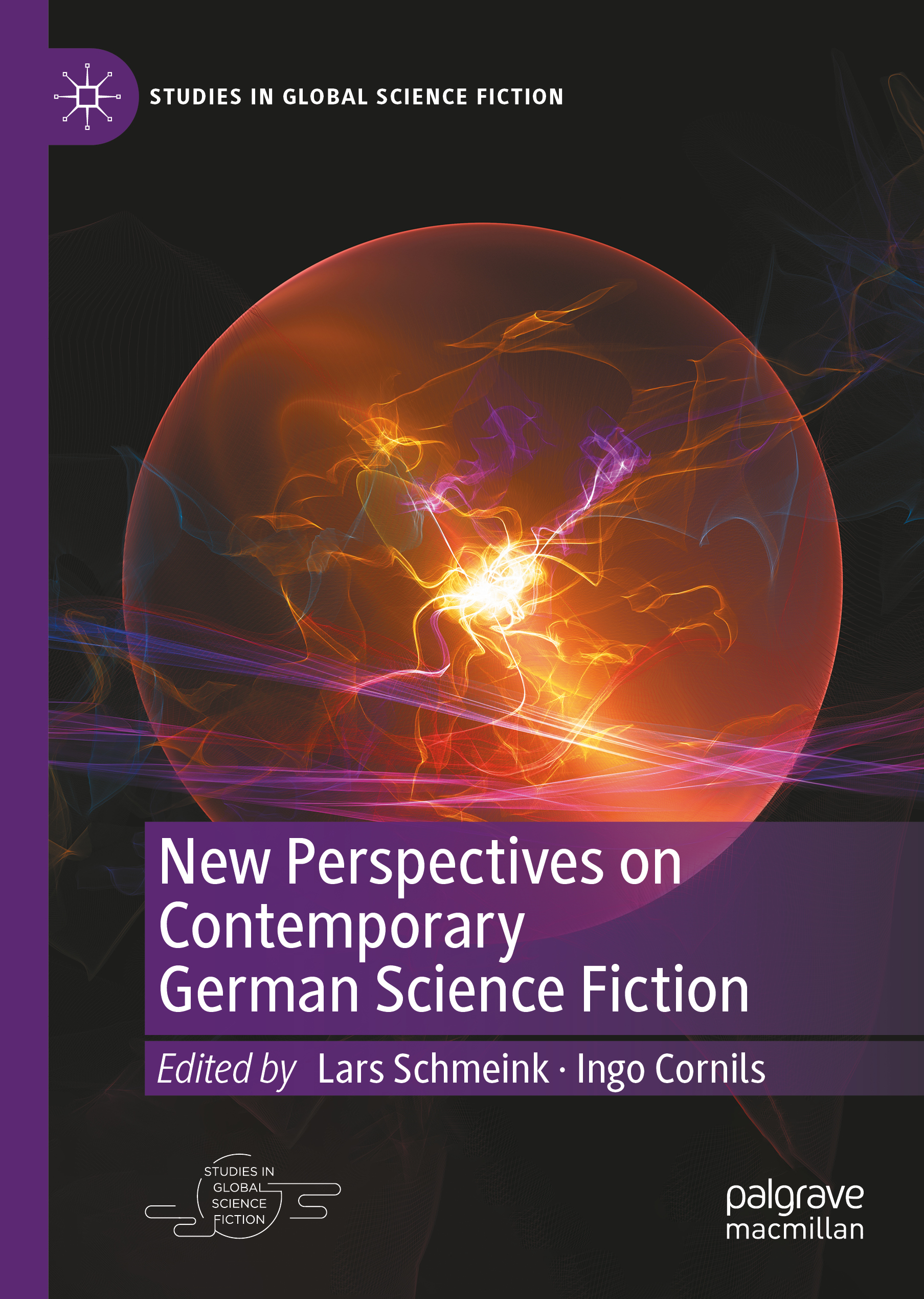
This volume https://link.springer.com/book/10.1007/978-3-030-95963-0 is now available in electronic and hard copy. Edited by our Leverhulme Visiting Professor Dr Lars Schmeink and myself, it contains fifteen chapters on recent German SF film, TV and books. My own chapter, ‘Dark Mirrors? German Science Fiction in the Twenty-First Century’, looks at recent German SF novels (Thomas von Steinaecker’s Die Verteidigung des Paradieses and Sibylle Berg’s GRM: Brainfuck), to analyse why and how they establish their dystopian worldview. But, in contrast to most of the contributions to this volume, I am also looking at the green shoots of positive visions (Tom Hillenbrand’s Qube, Andreas Brandhorst’s Die Eskalation, Judith and Christian Vogt’s Wasteland, and Andreas Eschbach’s Eines Menschen Flügel). These give us glimpses of “concrete utopias” even as they contemplate the destructive impact of human activity on our planet. I argue that these latter works demonstrate a radical rethinking of the purpose of writing SF in the twenty-first century, offering a “progressive fantastic,” and a new hope.

Since the turn of the millennium, German writers have increasingly engaged with moral and ethical dilemmas created by scientific and technological advances. But what can these texts tell us about the future?

You can listen to my take on this question in this podcast created for the Ilkley Literature Festival ‘Settee Seminars’: https://anchor.fm/ilkleyliteraturefestival/episodes/Ingo-Cornills—What-can-German-Science-Fiction-tell-us-about-the-future-e1ecnls

This volume, edited by my colleague (and Leverhulme Visiting Professor to Leeds) Dr Lars Schmeink and myself, will be published on 29 May 2022. It will provide readers with an up-to-date overview of the state of German SF in Literature, Film and TV.

https://link.springer.com/book/9783030959623

New Perspectives of Contemporary German Science Fiction (cover)

In September 2021, I will be presenting a ‘follow-on’ chapter to my book ‘Beyond Tomorrow’ at the Association of German Studies conference in Swansea and (as keynote) at the Gesellschaft für Fantastikforschung conference:

https://anglistik1.phil-fak.uni-koeln.de/abteilungen-lehrende/literaturwissenschaft/juniorprofessur-amerikanistik-prof-rauscher/events/gff-conference-speculative-fiction-and-ethics-sept-23-25-2021

German SF in the 21st century tends to see the dystopian form as the ideal vehicle to explore the social and psychological consequences of scientific and technological progress. There is no point in denying that the ‘dystopian turn’ reflects the mood of our time, and that the first two decades of the new millennium have given rise to fears and misgivings about increasingly porous boundaries, conceptual paradigm shifts, and persistent global challenges that make our scientific and technological advances feel hollow. At the same time, one may wonder whether the endless depiction of depressing futures in recent SF may not in fact yield diminishing returns in terms of the intended warning function and instead convince its audiences to give up hope altogether. In my talk I will look at recent German SF novels (Thomas von Steinaecker’s Die Verteidigung des Paradieses and Sibylle Berg’s GRM: Brainfuck), to analyze how they establish their dystopian world­view. But I will also be looking at the green shoots of positive visions (Tom Hillenbrand’s Qube, Andreas Brandhorst’s Die Eskalation, Judith and Christian Vogt’s Wasteland, and Andreas Eschbach’s Eines Menschen Flügel). These give us glimpses of “concrete utopias” even as they contemplate the destructive impact of human activity on our planet. I argue that these latter works demonstrate a radical rethinking of the purpose of writing SF in the 21st century, offering a “progressive fantastic”, and a new hope.

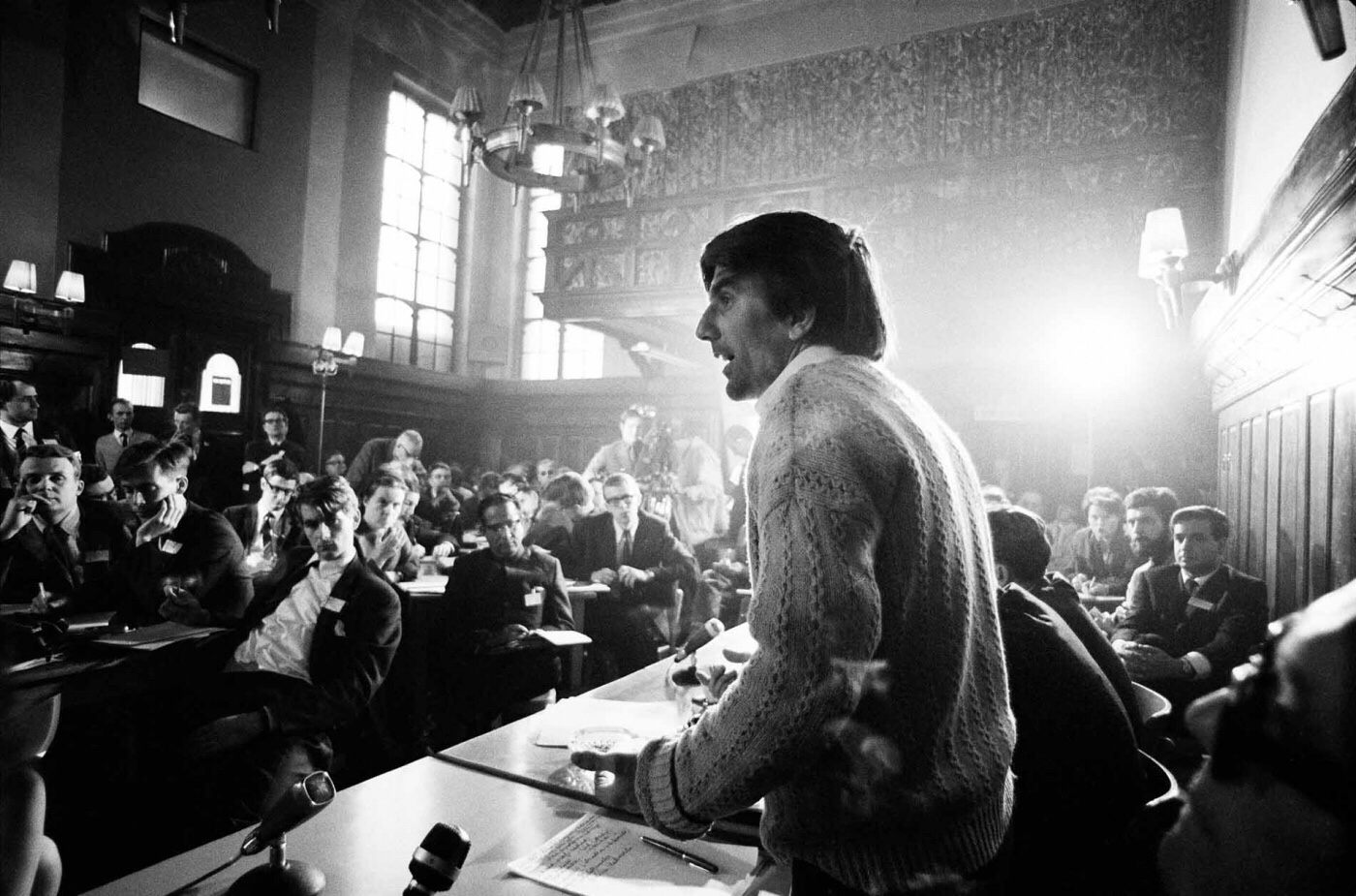
It is 50 years ago that one of the leading figures of the German Student Movement was shot in West Berlin. He survived, but had to retire from the limelight and died 11 years later from the long-term effects of the attack. It is a moot point whether the movement and the country as a whole would have taken a different direction had the assassin missed his target. He didn’t, and the New Left had both a martyr and an excuse for its ultimate failure. 20 years ago, I contributed a chapter to Gerard de Groot’s book ‘Student Protest. The Sixties and After’ (London / New York 1998). In it I quote Rudi’s simple message:

Our life is more than money. Our life is thinking and living. It’s about us, and what we could do in this world … It is about how we could use technology and all the other things which at the moment are used against the human being.… My question in life is always how we can destroy things that are against the human being, and how we can find a way of life in which the human being is independent of a world of trouble, a world of anxiety, a world of destruction.

Speculative Lunch at the Leeds Humanities Research Institute on 7 February 2018
This event brought together a wide range of participants from Leeds and York. Following an introduction by the organisers and brief presentations of their own research projects on Science Fiction, Fantasy and Utopian Texts, colleagues outlined their research interests, ranging from Tagore and political resistance, fairy tales, female mysticism, supernatural and disruptive elements in music, the posthuman, the decolonisisation of the future, to the fantastic in mainstream writing.
The discussion identified common ground in that, in the words of Ursula Le Guin, “by making realism the standard of quality, by limiting literature to it, we are leaving too much serious writing out of consideration.” In fact, ‘the fantastic is always there’, and has existed in mainstream cultural productions, eg magical realism or folk tales. This acknowledges the spiritual dimensions of our experience, including our conceptions of time, and provides us with a critical lens on (consensus?) reality.
Looking forward, there was a keen desire to explore ways to establish a research group on the transcultural fantastic, to explore our ‘utopian horizon’ through a series of Sadler Seminars in 2018/19 that would bring in experts and practitioners , explore the local history of Leeds as an epicentre of the fantastic, engage with the resources in our Special Collections in the Brotherton Library, and link with the Centre for World Literatures/Centre for World Cinemas and Digital Cultures.
Ingo Cornils (LCS/German) / Sarah Dodd (LCS/EAST) / Liz Stainforth (FAHAC)

I had forgotten how much fun it can be to simply ATTEND a conference, to network, listen and shamelessly go idea-mining. While my brain is fuzzing with possible opportunities I see how important a corrective to the anglo-centric discourse will be. Still, many thanks to the brilliant organisers of http://unsettlingscientificstories.co.uk/imagined-futures ! If you are interested in the action, follow #ImaginedFutures

Professor Zygmunt Bauman asked a significant question in his lecture ‘Europe’s adventure: still unfinished?‘ at the University of Leeds yesterday. Has the Vision of the Future lost its attraction?Should we retreat, just because the enormity of the task scares us, and because our cosmopolitan world is not yet matched by a cosmopolitan awareness? My new research project: Beyond Tomorrow. German Science Fiction and Utopian Thought in the 20th and 21st Century explores what German writers and thinkers can contribute to the debate, and in particular whether they can help us come to terms with the future: Zukunftsbewältigung.

The latest edition of the academic journal ‘literatur für leser’ is out now. ‘Forever Young? Unschuld und Erfahrung im Werk Hermann Hesses’ (Innocence and Experience in the Works of Hermann Hesse) features five essays in German and English by international scholars from the UK, Germany, Italy and Japan.

From the editorial:

Erfahrung, so der englische Dichter William Blake (1757-1827), kostet den Menschen alles was er hat. Für den deutsch-schweizerischen Schriftsteller Hermann Hesse (1877-1962), der dem englischen Mystiker in seiner Unbedingtheit auf vielfältige Weise ähnelt, trifft diese Maxime sicherlich im besonderen Maße zu. Aufgewachsen in einer pietistisch frommen Familie, wurde sein ‚Eigensinn‘ von frühester Jugend an systematisch herausgefordert. Eltern und Lehrer versuchten mit allen Mitteln, seinen Willen zu brechen: eine brutale Form der Erziehung, die der junge Hesse mit Eskapaden, Flucht und einem Selbstmordversuch beantwortete. Gleichzeitig wurden die religiösen Eckpfeiler, das Bewusstsein von Gut und Böse, von Schuld und Verdammnis, von Himmel und Hölle, tief in seine Psyche eingepflanzt. Das Problem einer dualistisch konstruierten Welt sollte ihn sein Leben lang beschäftigen und zu einem Gegenentwurf herausfordern, der die Vielfältigkeit der erfahrbaren Welt schätzt und gleichzeitig die Einheit hinter den Gegensätzen betont.

Wie manifestiert sich nun Hesses Versuch einer Synthese von Unschuld und Erfahrung? Dieser in der Forschung bisher wenig beachteten Frage gehen die Beiträger in diesem Themenheft nach. Sie zeichnen eine Entwicklungslinie von Peter Camenzind (Maike Rettmann) über Demian und Siddhartha (Jon Hughes), Hermann Hesses Faszination mit Schmetterlingen (Neale Cunningham) bis zu Hesses Glasperlenspiel (Sikander Singh) auf und stellen sie in einen ideengeschichtlichen, psychologischen und philosophischen Zusammenhang (Mauro Ponzi).

Ingo Cornils (ed.), Forever Young? Unschuld und Erfahrung im Werk Hermann Hesses, special edition of literatur für leser, 38. Jahrgang, Nr.1/15, Frankfurt/M.: Peter Lang 2016, ISSN 0343-1657


Sometimes a day at the Hay Festival is like mainlining Ernst Bloch’s Principle of Hope. Already in a receptive mood by listening to a radio interview with Jimmy Wales, the co-founder of Wikipedia. Yuval Noah Harari inspired his audience with visions that used to be found in the sf books of Olaf Stapledon and Dan Simmons. Mick Ebeling restores one’s faith in humanity with his notimpossible projects. Karen Armstrong challenged widespread assumptions about religion and war. A utopian space or a jolly for the middle class – can’t it be both?

Hermann Hesse’s pivotal role in helping to set up one of Germany’s most renowned publishing houses, the Suhrkamp Verlag, has long been recognised. However, little attention has been given to the programmatic and philosophical influence he had on Peter Suhrkamp and his successor Siegfried Unseld. This article analyses Hesse’s lasting impact on his publishers’ views, especially their commitment to European and World literature. It charts the development of Hesse’s thinking on Europe, explores Hesse’s relationship with Peter Suhrkamp and Siegfried Unseld, and demonstrates how Hermann Hesse’s books, political writings, correspondence and more than three thousand book reviews contributed to the ‘Suhrkamp Culture’.

Hermann Hesses zentrale Rolle bei der Gründung des renommierten Suhrkamp Verlags in Frankfurt ist allgemein bekannt. Wenig erforscht dagegen ist der programmatische und philosophische Einfluß, den er auf Peter Suhrkamp und seinen Nachfolger Siegfried Unseld ausübte. Der vorliegende Artikel analysiert Hesses nachhaltige Wirkung auf das Denken seiner Verleger, besonders ihr Engagement für europäische und Weltliteratur. Er zeichnet die Entwicklung des Hesse’schen Denkens in Bezug auf Europa nach, untersucht dessen Beziehung zu Peter Suhrkamp und Siegfried Unseld, und zeigt, wie Hermann Hesses Bücher, politische Schriften, Korrespondenz, sowie seine mehr als dreitausend Buchrezensionen zur ‘Suhrkamp Kultur’ beigetragen haben.

in: German Life and Letters, Volume 68Issue 1pages 54–65January 2015

Between Bauhaus and Bügeleisen: The Iconic Style of Raumpatrouille (1966) The German television SF series Raumpatrouille (Space Patrol) has long gained cult status, in German-speaking countries it enjoys a similar popularity as the original Star Trek series which was first broadcast in the same year. Much has been made of Raumpatrouille’s alleged militaristic and xenophobic ideology by critics who saw in it an awkward melange of undigested Prussian and Nazi jingoism and Cold War paranoia. What hasn’t been widely understood (or acknowledged) was that the series sought to subvert authoritarian traditions by means of humour and a positive outlook. In Raumpatrouille’s alternative world in the year 3000, people are still recognisably human. Individualism and conformism continue to be at odds. While nation states have been abolished, strict hierarchies remain in (world) government and the military. Here, individualism is suppressed, even though, and this has been ignored by critics and researchers so far, insubordination saves the day in each episode. Indeed, the series communicated very different messages: a vision of a world where mankind has overcome barriers between genders and between nation states. This concrete Utopia is evoked in the introductory voiceover in each episode, but finds its main expression in the series’ distinctive visual style. This style is futuristic and functional, reflecting a desire amongst the younger generation and the cultural elites to escape the sense of claustrophobia pervading the post-war era and the ‘no experiments’ attitude of the West German government. The use of modern materials in the sets suggests a deliberate break with tradition, and a conscious homage to Bauhaus clarity and transparency. Technology is the means by which unheard-of things are done in this imagined future, be it the ability to live at the bottom of the sea, or the routine task of travelling amongst the stars. Of particular interest in this essay are the innovative solutions the series’ set designers came up with to translate the technological revolution of the 1960s, which in turn heralded a much broader change in mentality, into a future setting. The incorporation of the latest industrial design and technology into an imagined alternative world, just months before the cultural and political revolutions of 1967/68 transformed the world for real, indicates a rare moment of confidence. in: Ricarda Vidal / Ingo Cornils (eds.), Alternative Worlds. Blue-Sky Thinking since 1900, Oxford: Peter Lang 2015, pp.283-302

In an attempt to counteract the doom and gloom of the economic crisis and the politicians’ overused dictum that ‘there is no alternative’, this interdisciplinary collection presents a number of alternative worlds which were thought up over the course of the last century. While change at macro-level was the focus of most of the ideological struggles in the 20th century, the real impetus for change came from the blue-sky thinking of scientists, engineers, architects, sociologists, planners, and above all, writers, who imagined alternatives to the status quo. Following a roughly chronological order from the turn of the 19th century to the present, the book  explores  the dreams, plans and hopes, but also the nightmares and fears reflected in utopian thinking in the Western hemisphere. The alternative worlds at the focus of the individual essays can each be seen as crucial to the history of the past one hundred years. While each reflects its particular moment in time, they also inform historical developments in a wider sense and continue to resonate in present culture. Instead of presenting mere mind games, building and the concrete realisation of the dream are crucial to all of them – whether that means the restructuring of the earth itself, the construction of the perfect city, the creation of an alternative society on Earth or on Mars, or the physical preservation of youth. The tension of dream and reality, of fact and fiction, which characterises all of these utopias is also represented in the interdisciplinarity of the volume which brings together contributions from the sciences and the arts.

Ricarda Vidal / Ingo Cornils (eds.) Alternative Worlds. Blue-Sky Thinking since 1900, Oxford: Peter Lang, 2014

Rainer Werner Fassbinders Welt am Draht ist ein außerordentlich vielschichtiger Film, der zu Unrecht von Kritik und Wissenschaft bislang vernachlässigt wurde. Welt am Draht ist eine visuelle Adaption des Romans Simulacron-3 von Daniel F. Galouye (erschienen 1964), die Fassbinder 1973 für den Westdeutschen Rundfunk als zweiteiligen Fernsehfilm realisierte. 2010 wurde die digital restaurierte Fassung auf der 60. Berlinale in Berlin und im Museum of Modern Art in New York einem breiteren Publikum vorgestellt. Die nach fast vier Jahrzehnten Obskurität endlich gegebene breite Verfügbarkeit sowie ein Cluster von neuen, durch Welt am Draht beeinflussten Filmen laden dazu ein, dessen künstlerische Originalität und langfristige Wirkung zu untersuchen. Hierbei sollen zwei Aspekte beleuchtet werden: Welt am Draht als wichtiges Bindeglied in der Geschichte der Science Fiction und des phantastischen Films, und als zentraler deutscher Beitrag zur Ikonographie apokalyptischen Denkens.

in: Veronika Wieser et. al. (eds), Abendländische Apokalyptik. Kompendium zur Genealogie der Endzeit, Berlin: Akademie Verlag 2013, pp.285-298, ISBN 978-3-05-005797-2 

Listening to Patrick Ness at the Hay Festival I asked myself whether utopian thinking is only for the ‘young adult’ market. True, a modicum of innocence helps if one is considering what kind of world we want to live in, but it takes courage to still insist on the possibility of change when one does so from the vantage point of experience. William Blake knew it, Hermann Hesse explored it in the Glass Bead Game, and now Patrick Ness has taken up the challenge. Impressive!

You are only young once, they say, but doesn’t it go on for a long time? More years that you can bear. (Hilary Mantel)

It is 45 years ago to the day that one of the leading figures of the German Student Movement was shot in West Berlin. He survived, but had to retire from the limelight and died 11 years later from the long-term effects of the attack. It is a moot point whether the movement and the country as a whole would have taken a different direction had the assassin missed his target. He didn’t, and the New Left had both a martyr and an excuse for its ultimate failure. 15 years ago, I contributed a chapter to Gerard de Groot’s book ‘Student Protest. The Sixties and After’ (London / New York 1998). In it I quote Rudi’s simple message:

Our life is more than money. Our life is thinking and living. It’s about us, and what we could do in this world … It is about how we could use technology and all the other things which at the moment are used against the human being.… My question in life is always how we can destroy things that are against the human being, and how we can find a way of life in which the human being is independent of a world of trouble, a world of anxiety, a world of destruction.


I am currently writing a review of Alan Corkhill’s impressive new book Spaces for Happiness in the Twentieth Century German Novel. This reminded me that in Uwe Timm’s novel Rot (2001), the protagonist comes across a Marcuse quote that has lost none of its relevance:

Der Gedanke, daß Glück eine objektive Bedingung ist, die mehr als subjektive Gefühle verlangt, wurde wirksam verdunkelt; seine Gültigkeit hängt von der wirklichen Solidarität der Gattung ‚Mensch’ ab, die eine in antagonistische Klassen und Nationen aufgespaltete Gesellschaft nicht erzielen kann. Solange die Geschichte der Menschheit derart beschaffen ist, wird der ‚Naturzustand’, wie geläutert auch immer, vorherrschen: ein zivilisierter bellum omnium contra omnes, in dem das Glück der einen mit dem Leid der anderen zusammen bestehen muß.

It’s been twenty years since I completed my PhD thesis on the changes in mood and perception from English Romanticism to English Science Fiction. In the second half of my thesis, I analysed the works of the British Science Fiction writer Richard Cowper (John Middleton Murry jr, 1926-2002). I am surprised that there haven’t been any other studies exploring RC’s rich, intricate and beautifully written novels and short stories. RC was kind enough to congratulate me at the time, writing:

“Seers and Sayers” is a truly handsome production and I feel honoured to have featured in it. […] I especially relished the title which – if memory serves me correctly – was the one I thought up way back in the 60’s and gave to Jimmy Haverill’s book on the Romantics which led to his getting the assistant lectureship at Hampton. Thus, as the phrase has it, does the wheel come full circle…

Sadly, this monumental achievement (written by David Mitchell,  transferred to the silver screen by Lana and Andy Wachowski / Tom Tykwer, and beautifully created by Babelsberg Film Studios) has come and gone without leaving a major impression on the British film-going public. I took the students from  my ‘German Utopian Thought in Fiction and Film’ seminar and they were very taken with the way utopian ideas and imagery were employed in this production. I believe that both book and film will stand the test of time, and, like Ridley Scott’s much maligned ‘Prometheus’, give people food for thought for many years to come. Everything is connected!

I wonder how many people are out there agree with me that it is high time to connect the dots between Friedrich Hölderlin, John Keats, Henry Wadsworth Longfellow, Richard Cowper, and of course Dan Simmon. Anyone familiar with Dan Simmon’s Hyperion Cantos will know that the titanic struggle between the Core AIs and their creators (us) reverberates across space and time, and thus it is no surprise that the Romantics got caught up in it. Having written my PhD thesis on the works of Richard Cowper (who relies heavily on William Blake and John Keats), I am keen to explore all possible avenues from classics to cyberspace. On he flared…

When students in my German Student Movement seminar started experimenting with Prezi instead of the usual Powerpoint, I felt inspired to explore what I could do with a less linear, more dynamic and intuitive presentation software. I have done a dry-run a few weeks ago in my School and everything worked fine – the audience certainly seemed interested. Now for the real test – using a Prezi to help me talk to a paper at our annual Association for German Studies Conference in Cardiff: http://prezi.com/hvxmvd-2uu_9/not-dark-yet/

The material is drawn from Chapter 12 of my monograph-in-progress on the construction of ‘1968’ in Germany.

Let’s just hope they have a good internet connection…

With the integration of its core themes and narrative strategies into the mainstream, science fiction in its traditional sense appears to have lost its competitive edge and its innovative potential. At the same time, its critical elements have survived in the area of alternative history fictions, notably in German-language literature. This paper analyses three recent examples: Christian Kracht, Ich werde hier sein im Sonnenschein und im Schatten (2008), Wolfgang Jeschke, Das Cusanus Jahr (2005), and Rob Alef, Das magische Jahr (2008). The objective is to explore how a classical device of fantastic literature is employed to introduce utopian/dystopian elements and challenge the status quo. As a vehicle for subversive cultural criticism, German alternate history fictions prove to be both flexible and relevant.

in: Lars Schmeink / Astrid Böger (eds), Collision of Realities. Establishing Research on the Fantastic in Europe, pp.325-338, Berlin: de Gruyter 2012

The German television SF series Raumpatrouille (Space Patrol) has long gained cult status, in German-speaking countries it enjoys a similar popularity as the original Star Trek series which was first broadcast in the same year. Much has been made of Raumpatrouille’s alleged militaristic and xenophobic ideology by critics who saw in it an awkward melange of undigested Prussian and Nazi jingoism and Cold War paranoia. What hasn’t been widely understood (or acknowledged) was that the series sought to subvert authoritarian traditions by means of humour and a positive outlook.
In Raumpatrouille’s alternative world in the year 3000, people are still recognisably human. Individualism and conformism continue to be at odds. While nation states have been abolished, strict hierarchies remain in (world) government and the military. Here, individualism is suppressed, even though, and this has been ignored by critics and researchers so far, insubordination saves the day in each episode.
Indeed, the series communicated very different messages: a vision of a world where mankind has overcome barriers between genders and between nation states. This concrete Utopia is evoked in the introductory voiceover in each episode, but finds its main expression in the series’ distinctive visual style.
This style is futuristic and functional, reflecting a desire amongst the younger generation and the cultural elites to escape the sense of claustrophobia pervading the post-war era and the ‘no experiments’ attitude of the West German government. The use of modern materials in the sets suggests a deliberate break with tradition, and a conscious homage to Bauhaus clarity and transparency.
Technology is the means by which unheard-of things are done in this imagined future, be it the ability to live at the bottom of the sea, or the routine task of travelling amongst the stars. Of particular interest in this essay are the innovative solutions the series’ set designers came up with to translate the technological revolution of the 1960s, which in turn heralded a much broader change in mentality, into a future setting. The incorporation of the latest industrial design and technology into an imagined alternative world, just months before the cultural and political revolutions of 1967/68 transformed the world for real, indicates a rare moment of confidence.

forthcoming, in: Ricarda Vidal / Ingo Cornils (eds.), Alternative Worlds. Blue-Sky Thinking since 1900

This article examines the relationship between, and the importance of, myth and utopia in Hermann Hesse’s work, their development over several decades, and their significance for our understanding of the utopian. The question whether Hesse’s work tends more towards the mythological or the utopian has hitherto not been convincingly answered. I demonstrate that Hesse’s work initially oscillates between (Promethean) myth and utopia. This becomes very clear in Narziß und Goldmund, where the author engages with the problem of death. In Das Glasperlenspiel, however, Hesse uses myth to create a utopian moment. I argue that Hesse’s persistent search for the culmination point of human existence does not necessarily lead to transcendence, but rather makes possible a concrete utopia. According to Hesse, man is capable of reaching a new level of consciousness. His ‘theory of stages’ found itself on the sidelines in a time of collective ideologies but may become relevant in the context of a developing ‘global consciousness’ of autonomous individuals.

German Life and Letters, Vol.66, Issue 2, April 2013, pp.156-172

Following the global celebration of their 40th anniversary in 2008, the 68ers, especially in Germany, have increasingly been portrayed as a generation that has overstayed its welcome. With the portrayal of their increasing infirmity (of body if not of mind) comes a general disassociation with their former ideals and once radical political agenda. The revolution has not taken place, certainly not in the way they had imagined. What was once perceived as dangerous and strangely attractive to broad sections of German youth has become embarrassing, decidedly old-fashioned, and, in spite of occasional sympathetic portrayals in film or on TV, almost inexplicable to later generations.
Whilst their presence in the media has somewhat diminished, the 68ers have not yet disappeared from political and cultural debates: especially their literary production continues unabated, though, as will be argued, a new quality has entered their work. Their writing is deeply reflective, especially of their own increasing sense of being strangers in a strange land. The generation that hoped to die before they got old, that coined the phrase ‘Trau keinem über 30’ has left its ‘Prominenzphase’ during the Red-Green Coalition government from 1998 to 2005 and entered uncharted waters, a stage in life when one has one last chance to admit mistakes, forgive if not forget, and remember one’s defining moments in the light of a lifetime’s experience.
The texts I have chosen to illustrate my argument are Uwe Timm’s ‘Freitisch’, Friedrich Christian Delius’s ‘Als die Bücher noch geholfen haben’, Jochen Schimmang’s ‘Das Beste, was wir hatten’ and Bernd Cailloux’s ‘Gutgeschriebene Verluste’ (which made the longlist of the Deutscher Buchpreis 2012). Each of these writers has charted the history of their generation and its ever-changing ‘Befindlichkeit’ over decades, and their work continues to attract broad attention.
My paper argues that these chroniclers of their generation remain committed to the cause: the project of Germany’s ‘politische Alphabetisierung’ (H.M. Enzensberger), and an aesthetic programme that evolved out of the spirit of ’68. One last time they evoke the ‘Aufbruch einer Generation’, a movement that is unequalled in terms of its radical approach, but now with a wistful focus on its unfulfilled promise.

Paper for the AGS Conference in Cardiff, 3-5 April 2013