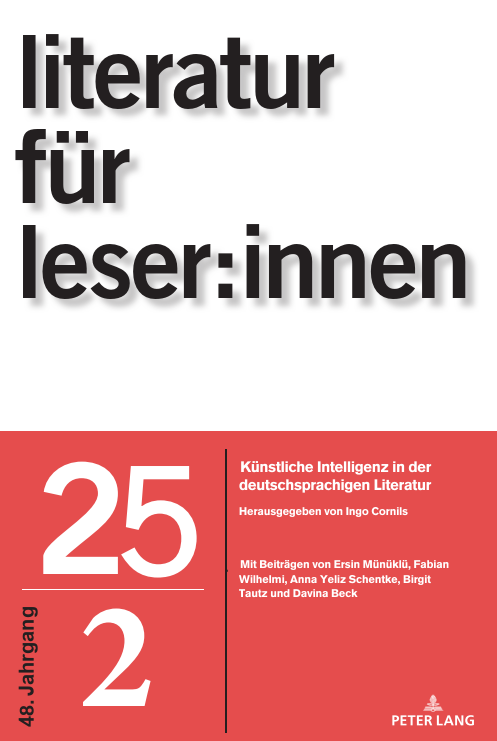
This special issue vividly demonstrates that literature’s ‘great game’ involving words, meaning, and form is currently undergoing a fundamental transformation. The contributors approach the subject from two angles: on the one hand, they examine AI-generated literature for its specifically machine-like style; on the other, they ask what form and function contemporary German-language authors assign to AI. The boundaries between these perspectives are fluid: AI—as a realm of possibility, programmed by humans yet capable of forging unforeseeable new connections—fuels human imagination (particularly regarding the integration and normalization of AI). This, in turn, heightens expectations for Artificial General Intelligence (AGI), a goal being pursued at full speed by research centers and so-called ‘frontier AGI companies’ such as OpenAI, Anthropic, Google DeepMind, xAI, and Aleph Alpha. Given these efforts, the concept of machine intelligence—a *deus ex machina* in the truest sense of the word—fulfills a vital function: it helps us grapple with the future—whether by serving as a warning against disastrous consequences, as a utopia of a symbiosis between human and (human-built) machine, or as the normalization of a new paradigm. For the way we represent AI in literature shapes our thinking about AI and how we wish to interact with it.

