When Hermann Hesse (1877-1962) wrote his fairy tale The Poet in 1913, he was at a crossroads. His career had gone well, taking him from obscurity as a romantic poet to national fame, but he knew full well that something was missing. He had established himself as a popular writer in Germany whilst avoiding the limelight in the backwater of Gaienhofen on Lake Constance but in 1912 moved with his family to a large house near Berne in Switzerland. As often as he could, he sought to escape his domestic situation: unhappiness with his ‘settled’ way of life, a problematic marriage – reflected in the novel Roßhalde (1914), and the duties of being a father to three sons. On a three-month sea voyage to Sumatra, Singapore, and Sri Lanka (Ceylon) in 1911, in the footsteps of his missionary parents and grandfather, he had hoped to experience the spirituality and philosophy of the mystical ‘East’ but found it corrupted by European influence. What stood out to him, though, were the radically different cultural ideals of the Chinese people he encountered. This experience stimulated his interest in the classics of Chinese literature and philosophy which at the time were translated into German by the Sinologist Richard Wilhelm (1873-1930).
The desire to completely devote oneself to art is comparable to a religious calling. It separates the devotee from wider society and earthly responsibilities, a hallmark of Romanticism. Hesse’s ability to romanticise his trip, and turn his ambivalent experiences into exquisite vignettes, can be seen in the description of the festival of lanterns that Han Fook observes. He does so with an intensity and yearning that rivals Goethe’s hero Faust who would sell his soul to the devil if he ever encountered such a moment. Hesse’s poem Nachtfest der Chinesen in Singapur (Chinese Moon Festival in Singapore), composed during the trip, was a first attempt to convey the (for Europeans) irresistible exotic mixture of lights, sounds, colours, and sensations. However, it is in the later fairy tale that Hesse effortlessly transfixes the observed, the observer, and the process of observing into the one perfect moment, a perfection that Han Fook must devote a lifetime to achieve.
A fairy tale always has a didactic intent, even though it is not explicit. In The Poet, we learn that art is not for everyone, that for the true devotee it means separation from society, complete dedication, and long periods of suffering, failure, and self-doubt. Hesse was used to this didactic form through his pietist upbringing. Moreover, at the time of writing The Poet, he was editing the Gesta Romanorum, a collection of fairy tales and legends from the (Christian) Middle Ages. Additional inspiration came from Richard Wilhelm’s translations of Daoist literature, including the collections of parables by Laozi (老子) and Zhuangzi (庄子). Hesse enthusiastically reviewed these when they were first published between 1910 and 1912, and later characterised them as “monuments of ancient wisdom.” Adrian Hsia has rightly pointed to Hesse’s “affinity” with Chinese thought and its influence. Indeed, Hesse would continue to explore the philosophy of opposites that enrich and complement each other. He was looking for the core of poetic expression: “…that secret art of saying what appears to be the simplest and plainest of things, but which bores into the listener’s soul like the wind into the mirror-surface of the water.” While his own art as a writer was already well advanced in The Poet, Hesse developed it in more sophisticated forms over the following three decades: in Steppenwolf, seeking a balance between humanity and animality, in Narcissus and Goldmund, reconciling the opposites of nature/feminine and logic/masculine, and in The Glass Bead Game, uniting the spiritual and the secular world that depend on each other.
What we have in Hesse’s fairy tale is a master storyteller using motifs from his own life, transcending them into a magical realm where dreams and desires can match and outweigh the pressures and expectations we face in real life. However, in stark contrast to the fairy tale where the twenty-year-old Han Fook realises his dream of becoming “a perfectly complete poet” by walking away from his “not wholly content” life to devote himself to perfection, the forty-year-old Hesse needed a series of personal crises and the rupture of a world war to enable him to reinvent himself and his art. And even though the power of reality is downplayed in The Poet, it still deserves our consideration.
We may think of Han Fook’s fiancé and of his father whose dreams and hopes are shattered. He claims to love them, he even returns to watch them, but he does not reveal or explain himself. When he finally becomes the “Master of the Perfect Word” himself, his father, his bride, and all the people he had ever known are dead, their anguish over his disappearance apparently not worth a single word. Our hero has gone on his quest, achieved serenity and perfection, yet he does not seem to have learned much in terms of empathy. Perhaps that is as it should be for exceptional individuals, and it is to Hesse’s credit that he imagines an alternative life for Han Fook who has a dream of being with his wife and children, even thinking about killing the Master who “had destroyed his life and cheated him of his future.” But this ‘disharmony’ is quickly overcome when the old man disarms him with “a faint, sad, gentle smile.” Ultimately, Han Fook’s growing powers as a poet count infinitely more as he becomes able to describe everything “in perfect musical harmony.”
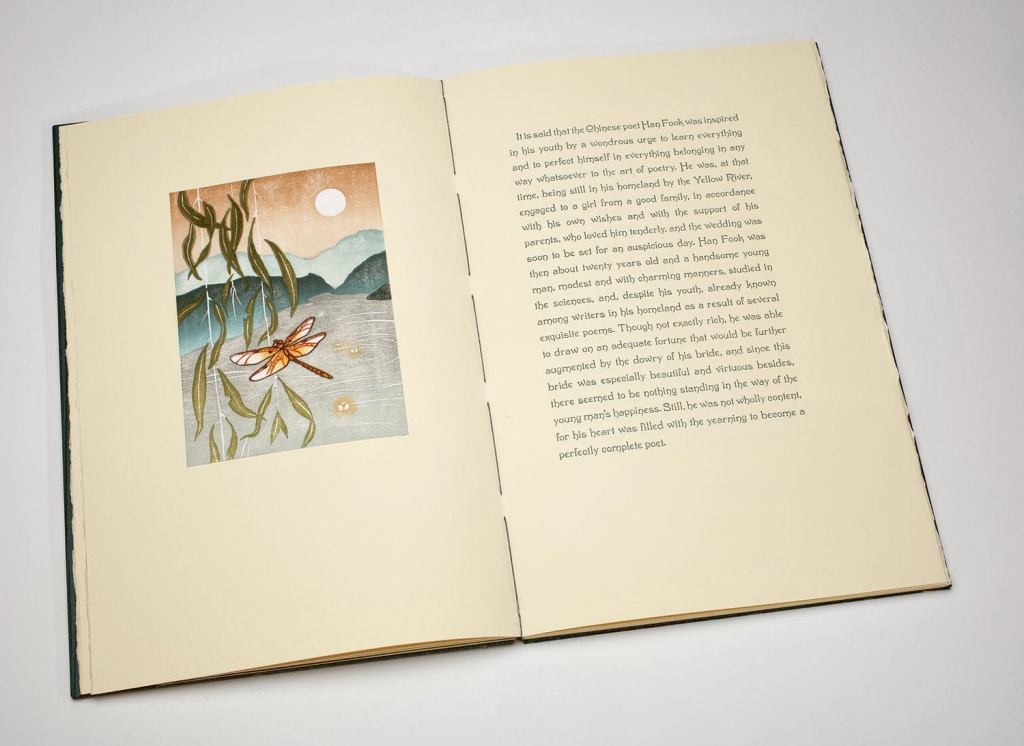
In a synthesis of Western and Eastern thought, Hesse wants us to think, but he does not tell us what to think. We are left with images that ‘bore themselves into our souls’, above all the floating lanterns on the river under a darkening blue sky and the flight of migrating birds. In an uncanny premonition, the story gives us glimpses of Hesse’s future writing after he left his own ‘old life’ behind: the tuition Siddhartha receives from the river, the tuition young Josef Knecht receives from the music master, perhaps even the tuition the disciples receive in Hesse’s Zen poems. It tells us about stillness, taking in, and – perhaps – giving back.
(c) Ingo Cornils
Notes on the text and its translation
Der Dichter (The Poet) was initially published as ‘Der Weg zur Kunst’ (The Way to Art) on 2 April 1913. It first appeared in book form in a selection of Hesse’s fairy tales (Märchen) in 1919, dedicated to Mathilde Schwarzenbach, the aunt of Hesse’s patron Georg Reinhart. She had helped him to finance book parcels for prisoners of war from 1915. Hesse still considered the text worthy of being recorded four decades later for a radio programme in 1955. An English translation by Denver Lindley first appeared in Strange News from Another Star in 1972.
Further reading
- Hermann Hesse, A Library of World Literature, (transl. by B. Venkat Mani), in: Journal of World Literature, 3 (4) 2018, 417-441. https://doi.org/10.1163/24056480-00304003
- Adrian Hsia, Hermann Hesse und China. Darstellung, Materialien und Interpretation, Frankfurt: Suhrkamp 1974, pbk 1981
- Joseph Mileck, Hermann Hesse and German Romanticism: An Evolving Relationship, in: The Journal of English and Germanic Philology, April 1983, Vol.82, No.2, pp.168-185
- Patricia J. Howard, Hermann Hesse’s „Der Dichter“: The Artist/Sage as Vessel Dissolving Paradox, in: Comparative Literature Studies, Spring 1985, Vol.22, No.1, pp.110-120
- Hermann Hesse, China: Weisheit des Ostens (ed. Volker Michels), Frankfurt: Suhrkamp 2009
- Ingo Cornils: A Companion to the Works of Hermann Hesse, Rochester: Camden House 2009, pbk 2013
- Gunnar Decker, Hesse. The Wanderer and his Shadow, Harvard University Press 2018
- Karl-Josef Kuschel, Im Fluss der Dinge: Hermann Hesse und Bertolt Brecht im Dialog mit Buddha, Laotse und Zen, Ostfildern: Patmos 2018
- Xianyun Tang / Boren Zheng, The Opposites and Unity: A Study of Chinese Taoist Thought found in Hermann Hesse’s The Glass Bead Game, in: Literature & Theology, Vol.34, No.4, December 2020, pp.503-509
- Neale Cunningham, Hermann Hesse and Japan. A Study in Reciprocal Transcultural Reception, Oxford: Peter Lang 2021
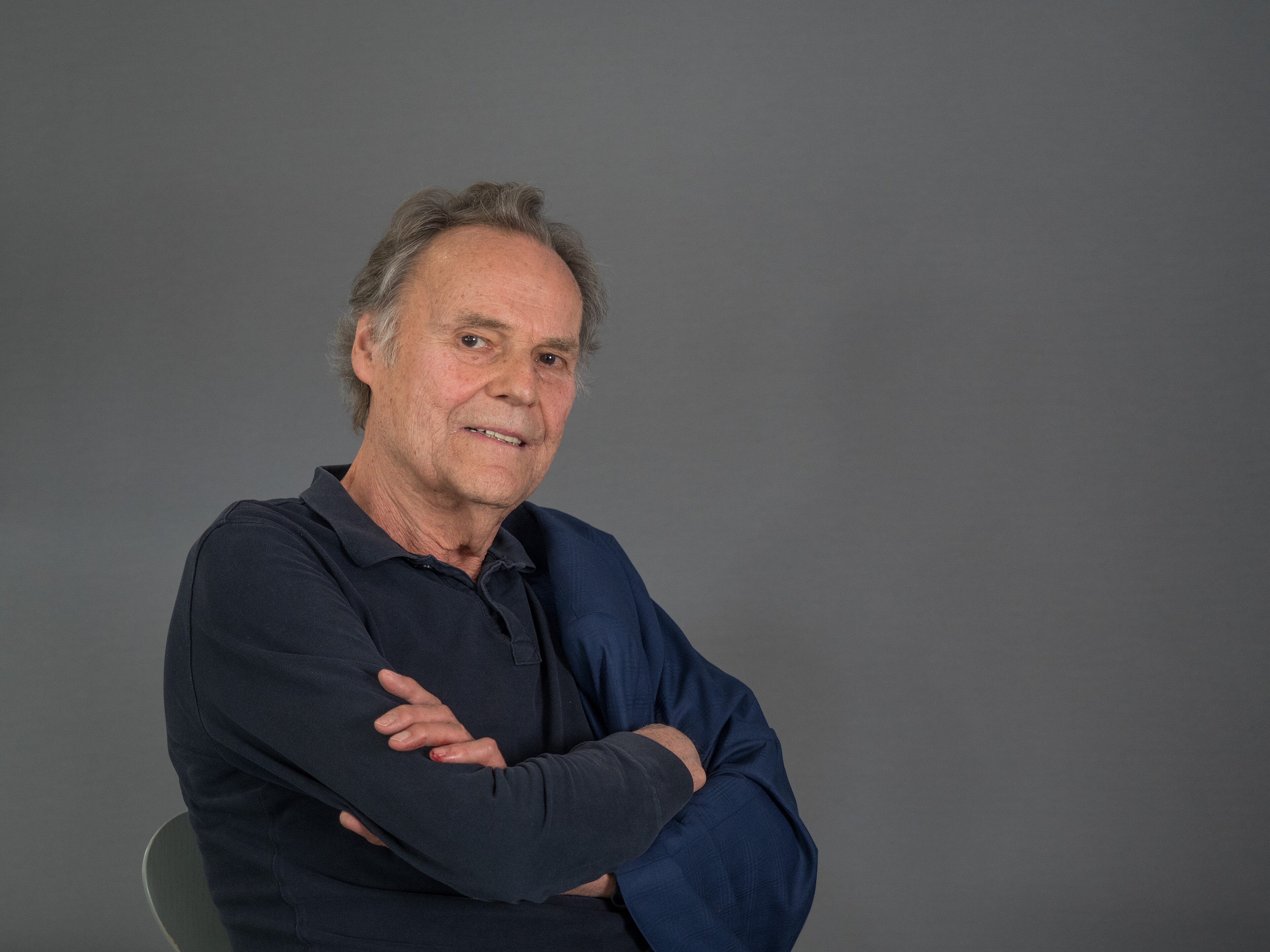
 Ingo Cornils