Archives for category: German Literature
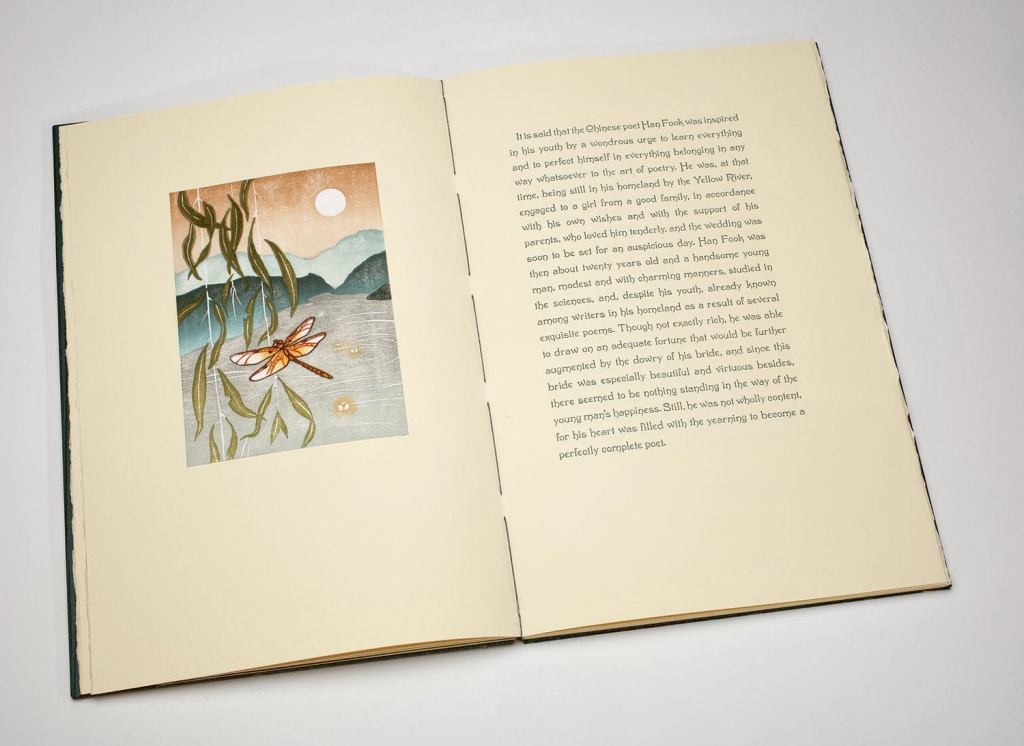
The current image has no alternative text. The file name is: hh-the-poet-nawakum-press.jpg

When Hermann Hesse (1877-1962) wrote his fairy tale The Poet in 1913, he was at a crossroads. His career had gone well, taking him from obscurity as a romantic poet to national fame, but he knew full well that something was missing. He had established himself as a popular writer in Germany whilst avoiding the limelight in the backwater of Gaienhofen on Lake Constance but in 1912 moved with his family to a large house near Berne in Switzerland. As often as he could, he sought to escape his domestic situation: unhappiness with his ‘settled’ way of life, a problematic marriage – reflected in the novel Roßhalde (1914), and the duties of being a father to three sons. On a three-month sea voyage to Sumatra, Singapore, and Sri Lanka (Ceylon) in 1911, in the footsteps of his missionary parents and grandfather, he had hoped to experience the spirituality and philosophy of the mystical ‘East’ but found it corrupted by European influence. What stood out to him, though, were the radically different cultural ideals of the Chinese people he encountered. This experience stimulated his interest in the classics of Chinese literature and philosophy which at the time were translated into German by the Sinologist Richard Wilhelm (1873-1930).

The desire to completely devote oneself to art is comparable to a religious calling. It separates the devotee from wider society and earthly responsibilities, a hallmark of Romanticism. Hesse’s ability to romanticise his trip, and turn his ambivalent experiences into exquisite vignettes, can be seen in the description of the festival of lanterns that Han Fook observes.  He does so with an intensity and yearning that rivals Goethe’s hero Faust who would sell his soul to the devil if he ever encountered such a moment. Hesse’s poem Nachtfest der Chinesen in Singapur (Chinese Moon Festival in Singapore), composed during the trip, was a first attempt to convey the (for Europeans) irresistible exotic mixture of lights, sounds, colours, and sensations. However, it is in the later fairy tale that Hesse effortlessly transfixes the observed, the observer, and the process of observing into the one perfect moment, a perfection that Han Fook must devote a lifetime to achieve.

A fairy tale always has a didactic intent, even though it is not explicit. In The Poet, we learn that art is not for everyone, that for the true devotee it means separation from society, complete dedication, and long periods of suffering, failure, and self-doubt. Hesse was used to this didactic form through his pietist upbringing. Moreover, at the time of writing The Poet, he was editing the Gesta Romanorum, a collection of fairy tales and legends from the (Christian) Middle Ages. Additional inspiration came from Richard Wilhelm’s translations of Daoist literature, including the collections of parables by Laozi (老子) and Zhuangzi (庄子). Hesse enthusiastically reviewed these when they were first published between 1910 and 1912, and later characterised them as “monuments of ancient wisdom.” Adrian Hsia has rightly pointed to Hesse’s “affinity” with Chinese thought and its influence. Indeed, Hesse would continue to explore the philosophy of opposites that enrich and complement each other. He was looking for the core of poetic expression: “…that secret art of saying what appears to be the simplest and plainest of things, but which bores into the listener’s soul like the wind into the mirror-surface of the water.” While his own art as a writer was already well advanced in The Poet, Hesse developed it in more sophisticated forms over the following three decades: in Steppenwolf, seeking a balance between humanity and animality, in Narcissus and Goldmund, reconciling the opposites of nature/feminine and logic/masculine, and in The Glass Bead Game, uniting the spiritual and the secular world that depend on each other.

What we have in Hesse’s fairy tale is a master storyteller using motifs from his own life, transcending them into a magical realm where dreams and desires can match and outweigh the pressures and expectations we face in real life. However, in stark contrast to the fairy tale where the twenty-year-old Han Fook realises his dream of becoming “a perfectly complete poet” by walking away from his “not wholly content” life to devote himself to perfection, the forty-year-old Hesse needed a series of personal crises and the rupture of a world war to enable him to reinvent himself and his art. And even though the power of reality is downplayed in The Poet, it still deserves our consideration.

We may think of Han Fook’s fiancé and of his father whose dreams and hopes are shattered, especially in a culture that was less individualistic than Western cultures. He claims to love them, he even returns to watch them, but he does not reveal or explain himself. When he finally becomes the “Master of the Perfect Word” himself, his father, his bride, and all the people he had ever known are dead, their anguish over his disappearance apparently not worth a single word. Our hero has gone on his quest, achieved serenity and perfection, yet he does not seem to have learned much in terms of empathy. Perhaps that is as it should be for exceptional individuals, and it is to Hesse’s credit that he imagines an alternative life for Han Fook who has a dream of being with his wife and children, even thinking about killing the Master who “had destroyed his life and cheated him of his future.” But this ‘disharmony’ is quickly overcome when the old man disarms him with “a faint, sad, gentle smile.” Ultimately, Han Fook’s growing powers as a poet count infinitely more as he becomes able to describe everything “in perfect musical harmony.”

In a synthesis of Western and Eastern thought, Hesse wants us to think, but he does not tell us what to think. We are left with images that ‘bore themselves into our souls’, above all the floating lanterns on the river under a darkening blue sky and the flight of migrating birds. In an uncanny premonition, the story gives us glimpses of Hesse’s future writing after he left his own ‘old life’ behind: the tuition Siddhartha receives from the river, the tuition young Josef Knecht receives from the music master, perhaps even the tuition the disciples receive in Hesse’s Zen poems. It tells us about stillness, taking in, and – perhaps – giving back.

(c) Ingo Cornils

Notes on the text and its translation

Der Dichter (The Poet) was initially published as ‘Der Weg zur Kunst’ (The Way to Art) on 2 April 1913. It first appeared in book form in a selection of Hesse’s fairy tales (Märchen) in 1919, dedicated to Mathilde Schwarzenbach, the aunt of Hesse’s patron Georg Reinhart. She had helped him to finance book parcels for prisoners of war from 1915. Hesse still considered the text worthy of being recorded four decades later for a radio programme in 1955. An English translation by Denver Lindley first appeared in Strange News from Another Star in 1972.

Further reading

  • Hermann Hesse, A Library of World Literature, (transl. by B. Venkat Mani), in: Journal of World Literature3 (4) 2018, 417-441. https://doi.org/10.1163/24056480-00304003
  • Adrian Hsia, Hermann Hesse und China. Darstellung, Materialien und Interpretation, Frankfurt: Suhrkamp 1974, pbk 1981
  • Joseph Mileck, Hermann Hesse and German Romanticism: An Evolving Relationship, in: The Journal of English and Germanic Philology, April 1983, Vol.82, No.2, pp.168-185
  • Patricia J. Howard, Hermann Hesse’s „Der Dichter“: The Artist/Sage as Vessel Dissolving Paradox, in: Comparative Literature Studies, Spring 1985, Vol.22, No.1, pp.110-120
  • Hermann Hesse, China: Weisheit des Ostens (ed. Volker Michels), Frankfurt: Suhrkamp 2009
  • Ingo Cornils: A Companion to the Works of Hermann Hesse, Rochester: Camden House 2009, pbk 2013
  • Gunnar Decker, Hesse. The Wanderer and his Shadow, Harvard University Press 2018
  • Karl-Josef Kuschel, Im Fluss der Dinge: Hermann Hesse und Bertolt Brecht im Dialog mit Buddha, Laotse und Zen, Ostfildern: Patmos 2018
  • Xianyun Tang / Boren Zheng, The Opposites and Unity: A Study of Chinese Taoist Thought found in Hermann Hesse’s The Glass Bead Game, in: Literature & Theology, Vol.34, No.4, December 2020, pp.503-509
  • Neale Cunningham, Hermann Hesse and Japan. A Study in Reciprocal Transcultural Reception, Oxford: Peter Lang 2021

The essay is part of a special focus on Utopia, Dystopia, and Climate Fiction in Gegenwartsliteratur: Ein germanistisches Jahrbuch / A German Studies Yearbook (edited by Friederike Eigler). It is available to download (open access) here.

Abstract: As the Intergovernmental Panel on Climate Change warns that the world is close to irreversible climate breakdown, Climate Fiction (Cli-Fi) furnishes our imagination with grim scenarios of the future. German writers add their voices to a global discourse when they explore the social and psychological impact of climate change. However, one may wonder whether their endless depiction of dark futures does not in fact yield diminishing returns. ‘Mainstream’ writers are often praised for their Sprachmächtigkeit, their ability to couch the destructive effects of climate change in poetic language. ‘Genre’ writers supply us with ever more depressing apocalyptic visions of the future. This essay, a critical survey of a burgeoning field, analyzes German literary Cli-Fi and climate thrillers, but also considers more hopeful examples as well as progressive Young Adult novels. By taking a synoptic approach, it seeks to determine German Climate Fiction’s contribution to the task of Zukunftsbewältigung.

Last week, I presented a paper at the Once and Future Fantasies Conference in Glasgow as part of a panel titled: Changing the Genre for a Better Tomorrow: Manifesting Progressive Science
Fiction in Germany
.

Andreas Eschbach’s novel, Eines Menschen Flügel (2020) weaves together elements of SF and fantasy, creating a minutely designed future world on which humans have been genetically altered to have wings. The novel appears to be targeted at a YA readership, and yet it contains a series of messages and philosophical reflections on the role of science and ‘progress’ as well as the posthuman condition that make it a rewarding read for adult readers as well. The ‘avian’ society is based on mutual help, everyone shares what they have and contributes towards the common good. Writing at a time when social divisions, identity politics, fears of terrorism, right-wing populism, and environmental disasters have created a seemingly all-pervasive dystopian mood in Germany, the bestselling author offers a (precarious) concrete utopia. My paper explored whether a ‘progressive fantastic’ can escape its niche of worthy but commercially unsuccessful productions and enter the mainstream.

This volume https://link.springer.com/book/10.1007/978-3-030-95963-0 is now available in electronic and hard copy. Edited by our Leverhulme Visiting Professor Dr Lars Schmeink and myself, it contains fifteen chapters on recent German SF film, TV and books. My own chapter, ‘Dark Mirrors? German Science Fiction in the Twenty-First Century’, looks at recent German SF novels (Thomas von Steinaecker’s Die Verteidigung des Paradieses and Sibylle Berg’s GRM: Brainfuck), to analyse why and how they establish their dystopian worldview. But, in contrast to most of the contributions to this volume, I am also looking at the green shoots of positive visions (Tom Hillenbrand’s Qube, Andreas Brandhorst’s Die Eskalation, Judith and Christian Vogt’s Wasteland, and Andreas Eschbach’s Eines Menschen Flügel). These give us glimpses of “concrete utopias” even as they contemplate the destructive impact of human activity on our planet. I argue that these latter works demonstrate a radical rethinking of the purpose of writing SF in the twenty-first century, offering a “progressive fantastic,” and a new hope.

Since the turn of the millennium, German writers have increasingly engaged with moral and ethical dilemmas created by scientific and technological advances. But what can these texts tell us about the future?

You can listen to my take on this question in this podcast created for the Ilkley Literature Festival ‘Settee Seminars’: https://anchor.fm/ilkleyliteraturefestival/episodes/Ingo-Cornills—What-can-German-Science-Fiction-tell-us-about-the-future-e1ecnls

1968. A ten-year-old boy picks up a ‘Hobby Buch’ in his local library, expecting a ‘Boys Own’ treat of exciting snippets of information about rocketry, technology, geography, plants and animals, as well as games, puzzles and sundry tips to while away an afternoon on a rainy day in a small town in Northern Germany. Instead, he is confronted with a massive dose of Zukunftsoptimismus (optimism in the future): Signale vom Jupitermond, written by Robert Brenner (1931-). The book features a garish cover with robots and a spaceship, with a narrative purporting to extrapolate social and technological developments and presenting them in a state of happy conclusion.

The scene is set with a world cup quarter-final held in an arena in Rome, only it isn’t a human football team but robots from different universities around the globe who compete for a prize. The audience in the stadium, and the billions of viewers around the world, are entertained by the robots’ ability to manage physical and abstract tasks, with much teasing by the presenter when they get it wrong. The representatives of the participating universities, including Vic Curtis and his wife from Melbourne, gather for a post-match discussion with a global TV star and munch the latest food fad, the synthetically produced No. 412 that has just been introduced worldwide.

In a separate narrative strand, we get to know more people of the future: Urs Meyer is a primary school teacher in Zurich who looks after a group of twelve 5-year-olds in direct and remote sessions, making use of video conferencing and recorded lessons tailored to his pupils’ individual needs. One night, he has a chance video-chat with Ping-kai-hui, a research student at Bejing University. Ping has discovered strange signals coming from one of the Jupiter moons, Ganymed, and wants to share her discovery with someone.

Next day Urs goes shopping for a mate for his trained monkey, and bumps into Vic Curtis at the Frankfurt Ape centre (the Curtis’ are also shopping for a new pet whilst in Europe), and he tells them about Ping’s discovery. They pay with a ‘card’, and the narrator helpfully explains that all citizens’ data, their finances, health records, education, etc is centrally held in computer clusters (think Dave Eggers The Circle).

Image result for signale vom jupitermond robert brenner

As the story unfolds, we learn more about this world of tomorrow: people do not use private cars any more, except on holiday for fun, and they fly around the planet going where their work and inclination takes them. There is a world government in New Dehli, and most day-to-day administration is performed by computers in a form of an enlightened, planned economy that looks after human needs from cradle to grave. Resources are directed to where they are needed: old houses are cleanly demolished by giant machines and replaced by new ones in a matter of days, and people move with minimal luggage as everything they need in terms of clothing, food etc is available in every home at the press of a button.

To continue with the storyline: it transpires that the signals found by Ping come from aliens who must have established a foothold on that moon. Following a discussion between the world computer ELIAS and the wise world President Mbuku, a vast sum is allocated by ELIAS and Ping is put in charge of a team to plan a mission to find out more. In a matter of weeks, scientists and engineers from all over the world converge at the space port of New Dehli to work on the project. They fly to a rotating orbital station reminiscent of Kubrick’s classic film 2001: Space Odyssey, then to the human colony on Mars (a sort of a New Frontier town) and finally to Ganymede, where the encounter with the aliens makes for a dramatic finale.

Related image

If all this isn’t mind-blowing enough for the ten-year-old reader, the book also contains three interviews with people who are supposed to know about the future: there is Werner von Braun, the rocket pioneer, who is introduced as the ‘guiding light’ of Peenemünde (the production and launch site of the V2-rockets) and the current director of the American rocket research facility. There is the ‘founder’ of the new science of the future, a bona fide futurologist by the name of Ossip K. Flechtheim. And there is the philosopher and scientist Robert Jungk, who has a slightly gloomy view, not about science and technology, but about the growing global population.

2018. A 60-year-old University professor teaches a seminar on German Utopian Thought in Fiction and Film to a group of British students in the fourth and final year of their undergraduate programme. They are idealistic and sincere, but they hold very little hope for the future. They live in a world where pretty much everything that was depicted and predicted in Signale vom Jupitermond has become a reality: manual labour has been broadly delegated to machines, food is plentiful, entertainments are shared globally, and the world is their oyster. While we do not yet have a World Government, we are on a trajectory to a global society, with vast multicultural cities, instant global news networks, global tech firms that rival nations in terms of resources and influence, an intricately woven net of trade and transport routes, and a slowly growing collective awareness of each other’s motivations, needs and values.

The students have access to technology (Skype, facetime, whatsapp, Instagram, twitter, facebook) that enables them to communicate with every human being on the planet for free, and to research every question or problem they might take an interest in. They are well travelled and almost guaranteed to get a job, yet they are pessimistic about their prospects and do not expect to reach or surpass the living standard of their parents. In contrast to a small minority who believe social change is possible on the fringes of mainstream society, they do not believe in any utopian project. As they see it, while Brunner’s depiction of the future has become a reality on the technological side, the dream of a united humanity has run into the buffer of experience, causing widespread pessimism and disillusionment. Some of the reasons are obvious: worries about repaying their student loans, Brexit, migration, terrorism, fear of another financial crash, concern about the environment (fracking, climate change, plastic in the ocean), in short: an acute awareness of the fragility and complexity of life on Earth for 7.5 billion people has been with them all of their short adult lives. They simply cannot imagine that their future will be bright.

To these students, the most memorable message they picked up during their year abroad in Germany is a song by rappers K.I.Z., titled Hurra, die Welt geht unter (Hurray, the world is going down the drains, 2015).[1] The video accompanying the song shows three young men on a raft in the ocean, subsisting on meage rations of canned food and fish while looking for survivors following a nuclear holocaust. Their world view is cynical, cursing their elders for knowingly letting the world go to ruins. But these survivors see some positives: they do not have to live by the rules of the discredited older generation, they have no use for money, relationships are entered into, and ended, by mutual agreement, with offspring cared for by the collective. Each verse of the song is sung by a different rapper, and in between we hear the refrain from an operative in a nuclear bunker: “Und wir singen im Atomschutzbunker, hurra, die Welt geht unter.”

At the end of the video clip, the young men on the raft sight land: the island with the nuclear bunker where the few surviving operators open the doors to greet the newcomers. Obviously, the song and video borrow heavily from a global tradition of apocalyptic, post-catastrophe and end-of-days imaginaries ranging from Stanley Kubrick’s Dr Strangelove to Kevin Costner’s Waterworld and J.J. Abram’s TV series Lost. In a German context, any number of dystopian yarns (from Marlen Haushofer’s Die Wand and Carl Amery’s Der Untergang der Stadt Passau to Wolfgang Jeschke’s Das Cusanus Spiel and Tim Fehlbaum’s film Hell) have contributed to the message that the future will be bleak.

Somewhere over the last 50 years, we seem to have lost the belief in our ability to create a better world, a better future. For every idealistic imagination of a positive future, we can find a hundred depictions of our world going to pieces around us. What happened? Are we incapable of imagining a utopian outcome, that we can be the masters of our own destiny? Why are we so addicted to the masochistic pleasure of seeing our homes go up in flames? And why are we so afraid of the future if, to any objective observer and compared to fifty years ago, we now live in a much safer world, a world where more people die of obesity than hunger, where the threat of mutually assured destruction through nuclear war has receded, and in which we have almost promethean powers to manipulate and alter the world around us and ourselves. Who benefits from such a gloomy world-view and why are writers and film directors so easily complicit in creating catastrophic visions of the future?

The 60-year-old academic seeks answers. Having written a book about the construction of ‘1968’ as a utopian moment and how the feeling of a missed opportunity to create a better world has never really left Germans over the subsequent five decades, he now wants to find out whether erstwhile student leader Rudi Dutschke’s assertion that ‘Geschichte is machbar’ (we can make history) cannot also mean ‘Zukunft ist machbar’, that we can shape our own future.

To find out, we need to go back, to a moment in time when the future still seemed bright, and identify the key moments that changed the grand narrative of the future. As the future we imagine becomes the present and eventually a future of the past, what can these texts and films tell us? Can they still inspire us, and perhaps even help us prepare for that ‘undiscovered country’, or have they lost their purpose and are now only exhibits in a museum, to be taken out of storage to remind ourselves of our childish/naïve/innocent (or, if you lean to a different view, dangerous/subversive/utopian) dreams? Will they, like so many texts that once held great social relevance, become children’s stories?

[1] https://www.youtube.com/watch?v=XTPGpBBwt1w 

and so it begins: I have been given leave in 2018/19 to write this book for Camden House.

Beyond Tomorrow. German Science Fiction and Utopian Thought in the 20th and 21st Century will make a major intervention in German Studies and a significant contribution to debates in Futures Studies and Comparative Literature/Film Studies.

In German literature and film, as well as in German Studies more generally, the key focus and main emphasis since the end of World War II has rightly been Vergangenheitsbewältigung [coming to terms with the past]. The argument put forward by scholars, writers and critics is that only by understanding, and working through, the consequences of National Socialism, the Holocaust, the death of millions, the uprooting of entire populations and the destruction of entire cities can we avoid making the same mistakes again. However, there is a risk that such a singular focus on the past bypasses the rapid developments in science and technology (eg AI; genetic engineering) that require a thorough understanding of, and critical engagement with, our new capabilities so that we can make the right choices for their direction and control.

The book demonstrates how writing about possible futures has helped, and continues to help, society to understand, anticipate and cope with the consequences of scientific and technological advances. It combines a discussion of German utopian thought with a survey of the German utopian/dystopian literary and cinematic tradition. Through a close reading of selected examples from around 1900 to the present day that represent key milestones and major artistic achievements, it explores how German writers and film makers respond to the question of how humanity can match its technological advances with a commensurate social, ethical, and moral progress. It examines their visionary responses to global challenges and plots the trajectory of this ongoing inquiry. Whether in utopian anticipation or beneath a dystopian guise, I argue that these works have global relevance and contain valuable strategies for Zukunftsbewältigung [coming to terms with the future]: by imagining inspiring or disturbing futures, they enable us to shape the future.

German Science Fiction is rarely translated into English, nor acknowledged in the Anglophone research literature on utopian and dystopian writing (cp. Gregory Claeys, Dystopia. A Natural History, 2017). Nor is it analysed within its overall context: the last major study in English, William Fischer’s The Empire Strikes Out: Kurd Lasswitz, Hans Dominik and the Development of German Science Fiction was published in 1984 and had a narrow focus on texts from the first half of the 20th century. German Science Fiction tends to reflect specifically ‘German’ concerns stemming from the country’s historical experience which in turn has given rise to specific fears and sensitivities about totalitarian control, the fragility of civil society, and the environment. Precisely because of this sensitivity, German writers’ awareness of the potential consequences of our promethean capabilities means they are particularly able to influence the moral and ethical debates about the direction and implementation of scientific and technological advances. I argue that their works offer vital cognitive and affective strategies that need to be more widely shared to contribute to the transnational debate about the choices we are facing today (cp. Yuval Noah Harari, Homo Deus, 2016).

The project is timely, given the recent flurry of dystopian novels in Germany, no longer just by established SF authors but also ‘mainstream’ authors such as Christian Kracht, Karen Duwe, Thomas von Steinaecker, Juli Zeh and Uwe Timm, the recent contributions to Futures Studies by German academics such as Harald Welzer, Lars Schmeink or Hans Esselborn, and the growing research focus in the UK on the challenges of the future (cp. the RCUK Big Ideas for the Future report).

My new monograph Writing the Revolution. The Construction of ‘1968’ in Germany is coming out this month.

Given that in the course of this book I criticise a number of academics for not laying their cards on their table, declare their agenda, or, as Jürgen Habermas would put it, formulate their ‘erkenntnisleitende Interessen’, I would like to outline my own.

Born in 1958, I was too young to understand what was going on around 1968, but I had a general awareness that a revolt was taking place. The Vietnam War was shown live on television and my older brother started to grow his hair and play records by the Rolling Stones. In school, the older students started to rebel against ‘authoritarian’ regulations and published a student newspaper that lampooned our teachers (some of whom, as everyone knew in my town, had been enthusiastic Nazis). Later, a teacher asked us to look at a flyer produced by the Socialist German Student League which included the (to me) pythonesque line ‘In der Institution liegt die Gefahr der Institutionalisierung’ (the institution contains the risk of institutionalisation). I became interested in politics, and enthusiastically supported Willy Brandt in his 1972 re-election campaign (the ‘Reiten für Deutschland’ election poster portrayed Willy Brandt and his foreign minister Walter Scheel riding an Easy Rider style motorbike while their conservative rival Franz Joseph Strauß was loading his gun). Returning from an exchange year in the USA, I successfully ran for president of the student council (Schülermitverwaltung). On leaving school, I became a conscientious objector (which required facing a hearing and making your case) and delivered meals on wheels instead of learning how to salute.

My introductory seminar on German literature at the University of Hamburg in 1978 was conducted by Klaus Bartels, a 68er turned academic, with a selection of contemporary novels. It did not even occur to us first year students that this was a far cry from what our predecessors would have had to grapple with – the old syllabus of middle high German and Goethe having become optional. As a counterpoint to any romantic notions about the glorious 60s, my other academic guide was Dietrich Schwanitz (of Der Campus fame) who kept us grounded with his sarcasm.

While there was no sign of the 68ers in the Audimax where they had displayed the Unter den Talaren, Muff von tausend Jahren banner ten years before, there was still something of their anarchic spirit in the air – there were regular semester-long strikes, a variety of communist student groups (MSB Spartakus, Marxistische Gruppe) tried to get our attention, and the arts and humanities applied a very relaxed assessment practice: there were no marks on one’s ‘Scheine’ (certificates of achievement, which merely stated that one had taken part), nor was there a ‘Zwischenprüfung’ (an exam after the first four semesters) to determine whether one could progress to intermediate and advanced seminars. Indeed, students from all years, first semesters and veterans of 20 semesters attended any seminar of their choice, and smoking was absolutely required unless one was into knitting.

Outside campus, an alternative lifestyle had established itself in the Abaton Kino, Wohngemeinschaften, the Hafenstraße squats, vegetarian restaurants, and the countercultural Auenland, a venue for live bands with a notorious drug scene. The late 1970s were an odd mixture of second-hand experiences – the protest against the building of a nuclear power plant in Brokdorf near Hamburg, the Rasterfahndung against Red Army Faction terrorists, even the odd demonstration in front of the American consulate with helicopters flying low above us felt like someone else’s battles.

So why am I writing a book about the afterlives of 1968? The disclosure above already hints at a certain sympathy for the liberating and iconoclastic elements of the German Student Movement, a fairly typical attitude among Germans of my generation and recently immortalised in Gerhard Henschel’s Bildungsroman (2014). Nevertheless, for many years the 60s were completely off my radar while I completed a PhD with a thesis on English Romanticism and English Science Fiction, and then switched to teaching German language and current affairs in the UK. Yet what began to intrigue me, and has kept me intrigued over the last twenty years, is the on-going and accelerating production of texts, films, music, art and research that engages with this brief period in German history. With my research interests focused on the intersection of utopian, political and romantic thought, the German Student Movement is a fascinating manifestation of this nexus, its distinct blend of epiphany and subsequent loss so similar to the romantic period.

My own role in the construction of ‘1968’ may complicate matters – as an academic teacher, author of articles and book chapters, conference organiser and volume editor, I have contributed to the literature that I propose to analyse. At the same time, my familiarity with this vast body of works and their authors will, I hope, become useful in guiding the reader through the maze of publications.

I should stress that this book is not about the events of that bygone era – Anglophone readers interested in the events may wish to turn to Hans Kundnani’s Utopia or Auschwitz. Germany’s 1968 Generation and the Holocaust, (2009), or Timothy Scott Brown’s West Germany and the Global Sixties. The Antiauthoritarian Revolt, 1962-1978, (2013); those able to read German are spoilt for choice –, but rather about the edifice that has been constructed on top of these events by the media, writers and academics.

Why is this construction so important? While the generation of 68ers is leaving the stage, their erstwhile disruption, their belief in fundamental change, is endlessly re-examined, amplified, mythologised and instrumentalised. The ‘unity of thought, feeling and action’, the clarity of purpose associated with the cypher ‘1968’ has become a holy grail, an obsession for a cultural elite of intellectuals, writers, journalists, and opinion makers. The resultant myth of ‘1968’ has invaded the imagination of many through the writings of the few. This process cannot go on indefinitely – decisions have to be made whether a unified Germany can ‘move on’ from ‘1968’, by either accepting the tenets of the movement as a moral touchstone or by rejecting them as romantic relapse. This is not just important for insider debates in the German media, academia or literature, but for Germany’s political elites. The construction of ‘1968’ into something both unassailable and unattainable has dominated debates for almost five decades and arguably stymied the country’s ability to play its part on the global stage. My research will enable readers to see this process more clearly.